GST Registration in Singapore: When You Must Register

You must register for GST if your taxable turnover exceeds S$1 million over a calendar year (the retrospective test), or if you reasonably expect to exceed S$1 million in the next 12 months (the prospective test), applying within 30 days. Below the threshold you can register voluntarily. The GST rate is 9%.
Goods and Services Tax (GST) registration becomes compulsory once your taxable turnover crosses S$1 million. Below that you can choose to register voluntarily. The prevailing GST rate is 9%, and only GST-registered businesses may charge and claim it.
Compulsory registration: the S$1 million test
IRAS applies two tests, and you must check both:
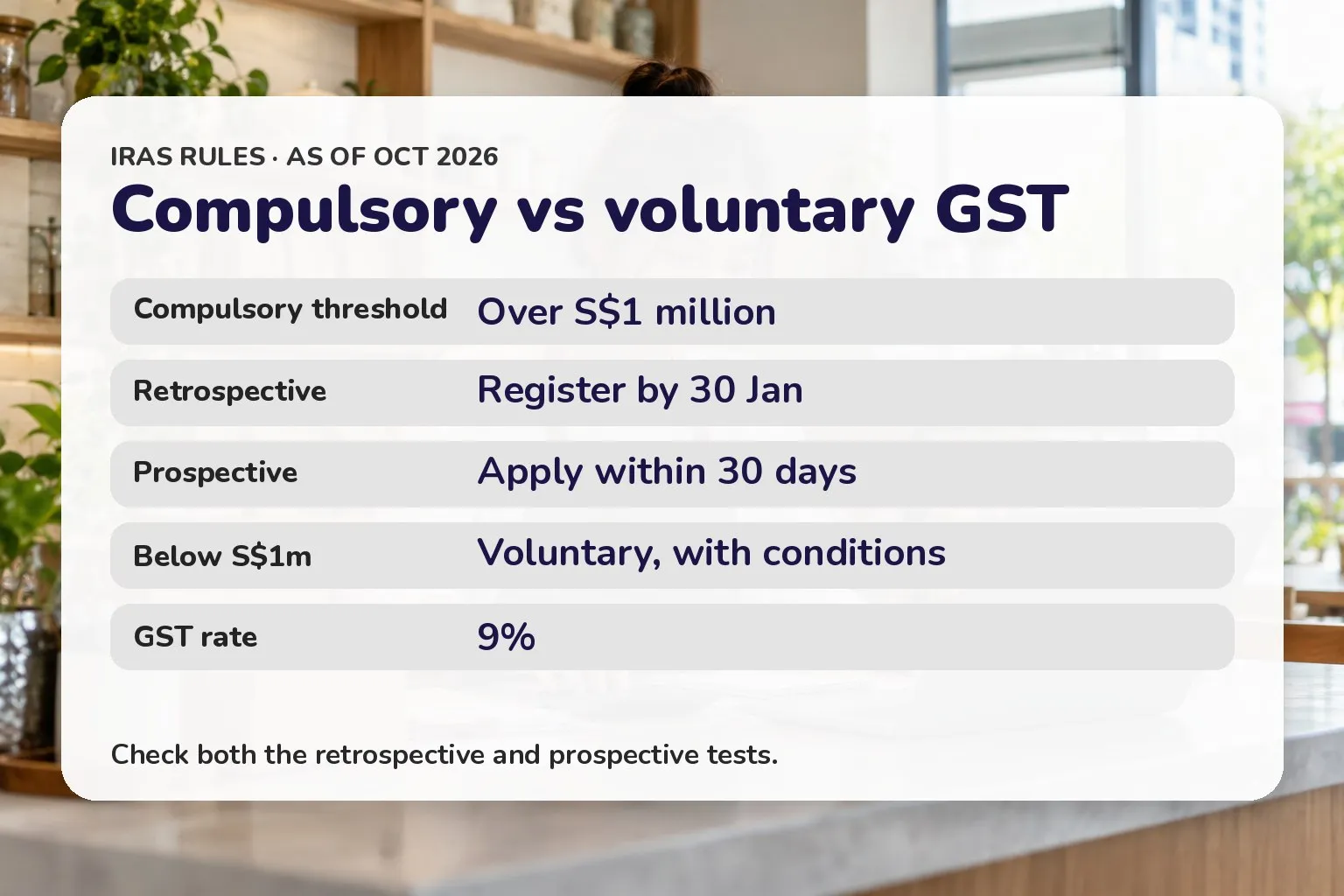
When GST registration is compulsory versus voluntary. Source: IRAS, as of October 2026.
- Retrospective view — at the end of the calendar year, was your taxable turnover more than S$1 million? If yes, you must register. The deadline is 30 January of the following year, and registration takes effect on 1 March.
- Prospective view — at any point, can you reasonably expect taxable turnover to exceed S$1 million in the next 12 months (for example, after signing a large contract)? If yes, you must apply for registration within 30 days of forming that expectation.
“Taxable turnover” is the total value of your standard-rated and zero-rated supplies — broadly, your taxable sales.
Voluntary registration
If your turnover is under S$1 million you may still register voluntarily, which lets you claim GST on your purchases. IRAS imposes conditions — for example staying registered for a minimum period and meeting its compliance and e-invoicing requirements — so weigh the admin against the benefit before you opt in.
What changes once you’re registered
Once registered you charge 9% GST on your taxable sales (output tax), can claim GST on eligible business purchases (input tax), and must file GST returns and pay any net GST to IRAS on time. New registrants are also being brought onto IRAS’s InvoiceNow e-invoicing requirement on a phased timeline, so factor that into your accounting setup.
Before you decide
GST interacts with the rest of your tax picture — see how corporate tax works for companies, and remember registration is separate from incorporating. If you’re unsure which test you meet, IRAS publishes worked examples, and an accountant can confirm your effective date.
Illustrative figures are for explanation only. Check IRAS for the current GST rules and thresholds, and confirm your own position before registering.
Sources
- Do I need to register for GST — Inland Revenue Authority of Singapore (as of October 2026)
- Goods and Services Tax (GST): What it is and how it works — Inland Revenue Authority of Singapore (as of October 2026)