Corporate Tax in Singapore Explained (17% + Exemptions)

Singapore taxes company profits at a flat 17% of chargeable income. A qualifying new company claims the start-up exemption for its first three Years of Assessment: 75% off the first S$100,000 and 50% off the next S$100,000. From the fourth year the partial exemption applies. File ECI within three months of your financial year end.
Singapore taxes a company’s profits at a flat 17% of its chargeable income — the same rate for local and foreign companies. What makes the effective rate much lower for small companies are two exemption schemes and the Year-of-Assessment (YA) system.
The 17% rate and chargeable income
Corporate income tax is assessed on a preceding-year basis: the profits of your financial year are taxed in the following Year of Assessment. “Chargeable income” is your taxable income after deducting allowable expenses. The headline rate applied to it is 17%.
Start-up tax exemption
A qualifying new company can claim the start-up tax exemption for its first three consecutive YAs:
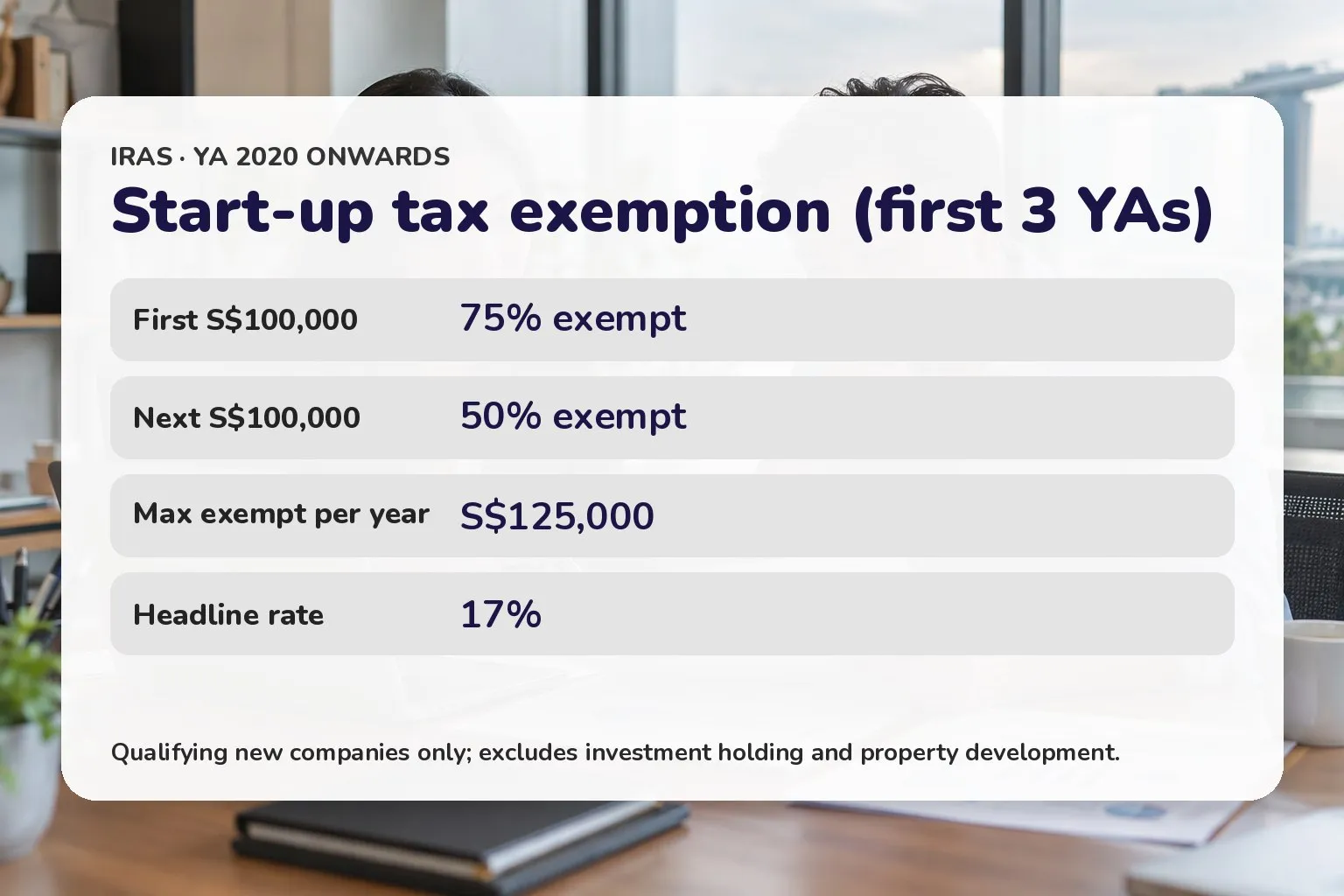
The start-up exemption on the first S$200,000 of chargeable income. Source: IRAS, as of October 2026.
- 75% exemption on the first S$100,000 of normal chargeable income, and
- a further 50% exemption on the next S$100,000.
That is up to S$125,000 exempt each year for the first three years. To qualify, the company must be incorporated in Singapore, be a tax resident for that YA, and have no more than 20 shareholders (with all being individuals, or at least one individual holding at least 10%). Investment-holding companies and property-development companies are excluded.
Partial tax exemption
From the fourth YA onward — or for companies that don’t qualify for the start-up scheme — the partial tax exemption applies: 75% off the first S$10,000 of normal chargeable income and 50% off the next S$190,000, up to S$102,500 exempt a year.
ECI: file within three months
Separately from your annual return, you must file an Estimated Chargeable Income (ECI) — your forecast of taxable income — within three months of your financial year end. There is a waiver if your annual revenue is S$5 million or less and your ECI is nil. Your actual return (Form C-S / Form C-S (Lite) / Form C) is then due by 30 November.
How this fits the bigger picture
Corporate tax sits alongside your other obligations: GST registration once you cross S$1 million in turnover, and ACRA’s annual filing. The structure you chose at incorporation decides whether you pay corporate tax at all — sole proprietors are taxed at personal rates instead.
Illustrative only; tax depends on your figures. Confirm your position with IRAS or a qualified accountant.
Sources
- Corporate Income Tax Rate, Rebates & Tax Exemption Schemes — Inland Revenue Authority of Singapore (as of October 2026)
- Basic Guide to Corporate Income Tax for Companies — Inland Revenue Authority of Singapore (as of October 2026)