Hiring Your First Employee in Singapore: Employer Duties

When you hire your first employee you must give written Key Employment Terms within 14 days, issue an itemised payslip with salary or within 3 working days, and register as a CPF employer. For a Singapore citizen or third-year-plus SPR aged 55 or below earning over S$750/month, employer CPF is 17% on wages up to the S$8,000 ceiling, plus a 0.25% SDL.
Hiring your first employee switches on several obligations at once. None are difficult, but they start from your first hire. These duties arise under the Employment Act, CPF Act and Skills Development Levy Act; breaches can lead to administrative penalties, interest and, in serious or unresolved cases, prosecution. Here is the core checklist.
Key employment terms, in writing
Under the Employment Act you must give every covered employee on a contract lasting 14 days or more their Key Employment Terms (KETs) in writing within 14 days of their start date. (The 14-day test concerns the length of the contract, not the number of days actually worked.) The KETs cover the basics: job title and duties, start date, working hours and rest days, salary and how it’s calculated, allowances and deductions, overtime rate, leave and medical benefits, and the probation and notice periods. It can be part of the employment contract, in soft or hard copy.
Itemised payslips
You must issue an itemised payslip with each salary payment, or within 3 working days of it. It breaks out basic pay, allowances, deductions (including the employee’s CPF), any overtime, and net salary. On termination or dismissal, the payslip must accompany the outstanding salary. Salary must generally be paid at least monthly and within 7 days after the end of the salary period; overtime pay is generally due within 14 days. Keep a record of payslips — for current employees the latest two years, and for ex-employees the last two years for one year after they leave.
Employer CPF
Before your first payroll, register as an employer with CPF Board to get a CPF Submission Number. CPF is generally required for employees who are Singapore citizens or SPRs earning more than S$50 in total wages for the month; the employee share phases in above S$500, and the full standard rates apply above S$750. For a Singapore citizen or third-year-and-onward SPR aged 55 and below earning more than S$750 a month, the standard split is:
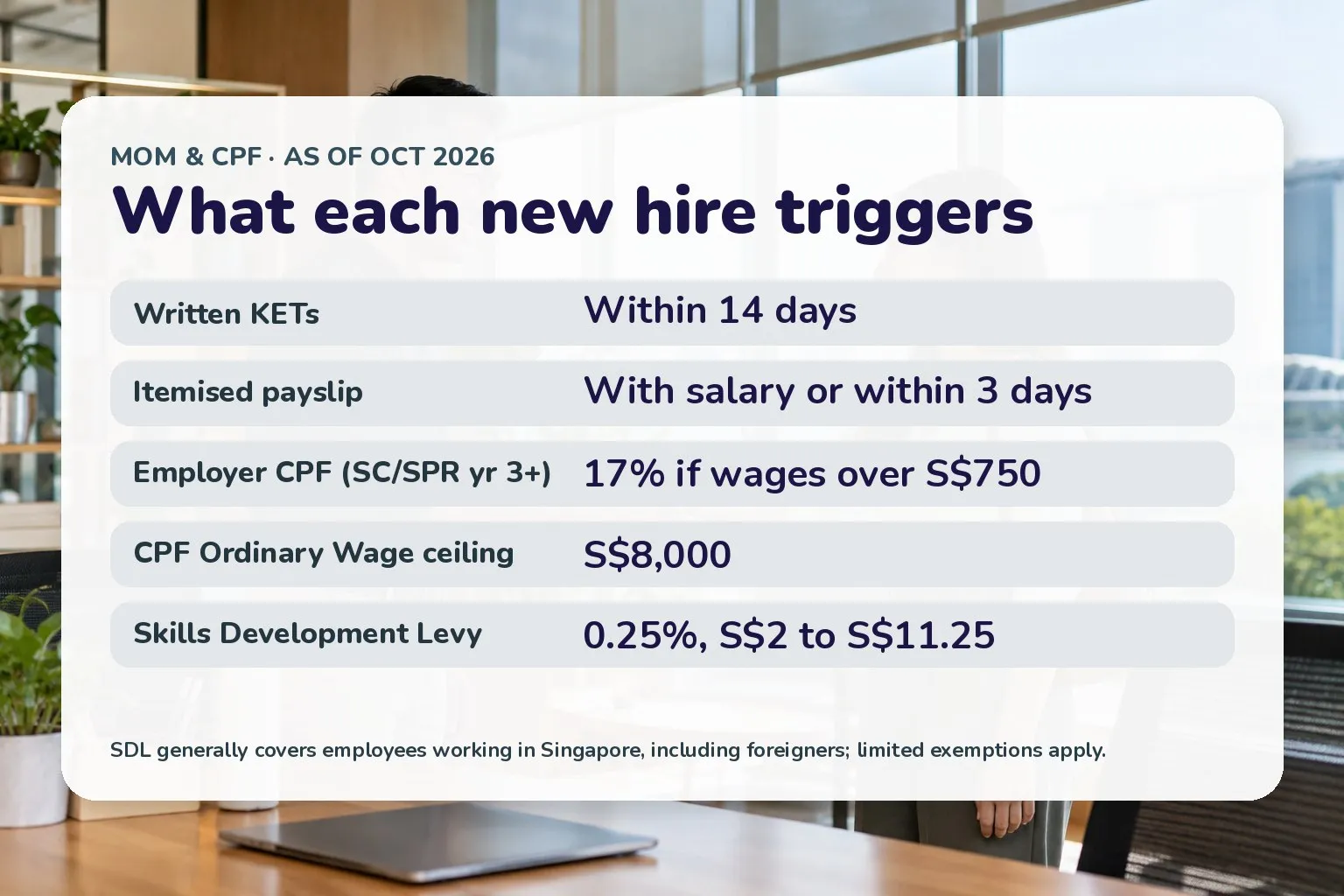
The main employer duties that start with your first hire. Summary by StartBizSG, based on MOM and CPF Board guidance, as of October 2026.
- Employer: 17% of wages
- Employee: 20% (which you withhold)
CPF is charged on Ordinary Wages up to the S$8,000 monthly ceiling (from 1 January 2026). The annual CPF salary ceiling remains S$102,000; the Additional Wage ceiling is S$102,000 minus the year’s Ordinary Wages already subject to CPF, so bonuses and other Additional Wages can still attract CPF. Graduated rates normally apply during an SPR’s first two years unless higher rates are jointly applied for, and rates step down for older workers. Foreign work-pass holders (EP, S Pass, Work Permit) attract no CPF — but “no CPF” does not mean “no levy or pass duties”: SDL still generally applies, and S Pass or Work Permit hires may also carry a foreign-worker levy and quota.
The Skills Development Levy
On top of CPF you pay the Skills Development Levy (SDL), which generally applies to every employee working in Singapore, including foreigners, subject to limited statutory exemptions: 0.25% of monthly wages, with a minimum of S$2 and a maximum of S$11.25. It is normally paid together with CPF, due by the 14th of the following month. If you employ only foreign employees, pay SDL directly to the SkillsFuture Singapore Agency (the Skills and Workforce Development Agency).
Year-end and the bigger picture
Singapore generally has no monthly payroll income-tax withholding; instead you prepare employment-income information (Form IR8A) for each employee by 1 March. AIS employers submit this electronically — the Auto-Inclusion Scheme is compulsory from five employees or when directed by IRAS. A separate tax-clearance rule applies when a non-Singapore-citizen employee ceases employment or leaves Singapore: you must file Form IR21 and withhold monies due to the employee. Payroll obligations sit alongside your company’s annual filing and corporate tax duties. If you’re still setting up, start with how to register a company.
Illustrative figures for explanation only. Check MOM and CPF Board for the current rates and rules, and confirm your own payroll with a professional.
Sources
- Key employment terms (KETs) — Ministry of Manpower (as of October 2026)
- Itemised pay slips — Ministry of Manpower (as of October 2026)
- How much CPF contributions to pay — Central Provident Fund Board (as of October 2026)
- What is the Ordinary Wage (OW) ceiling? — Central Provident Fund Board (as of October 2026)